AI agent framework decision guide 2026: CrewAI, LangGraph, Mastra, and more ranked by real-world fit

CTO of MadAppGang
Most teams evaluating AI agent frameworks in 2026 face the same problem: there are more than 20 tools to choose from, most of them look similar on a feature list, and the wrong choice means months of rework. Worse, a significant portion of what's marketed as "agent orchestration" isn't that at all.
We spent several weeks at MadAppGang going through this evaluation ourselves. We catalogued 20+ frameworks, stress-tested the marketing claims against GitHub issues and community discussions, and built enough proof-of-concept implementations to form opinions we'd actually stake a project on. The trigger was simple: we kept seeing teams — our own engineers included — spend days on framework selection only to discover that the tool they'd chosen was architecturally mismatched to the problem they were solving. This guide is the output of that research. It's written for the engineers and technical leads who need to pick a framework, and for the CTOs and engineering VPs who need to understand what their teams are getting into.
By the end, you'll know exactly which framework fits your team's language, budget, and complexity requirements — and which popular tools carry risks the marketing pages don't mention.
The most important distinction nobody makes clearly
Before comparing any framework, you need to understand a line that separates two fundamentally different categories of software. Most tools that appear in "best AI agent framework" roundups are actually workflow automation platforms — the AI equivalent of Zapier or Make — with an LLM node bolted on. True agent orchestration frameworks are architecturally different.
| Dimension | Workflow automation | Agent orchestration |
|---|---|---|
| Core primitive | Steps/nodes in a pipeline | Agents with roles, goals, and tools |
| Control flow | Deterministic branching | LLM-driven decisions and patterns |
| Multi-agent model | Sequential or parallel nodes | Delegation, handoffs, supervisor patterns |
| Memory | Workflow variables | Persistent cross-session context |
| Adaptability | Fixed paths | Dynamic routing based on reasoning |
| Examples | n8n, Dify, Make, Zapier | Mastra, LangGraph, CrewAI, AutoGen |
This distinction matters because the two categories solve different problems. If you need to automate a defined process — "when a form is submitted, send a Slack message and create a CRM record" — a workflow platform is exactly the right tool. If you need agents that reason, delegate tasks dynamically, use tools based on context, and maintain state across sessions, you need an orchestration framework.
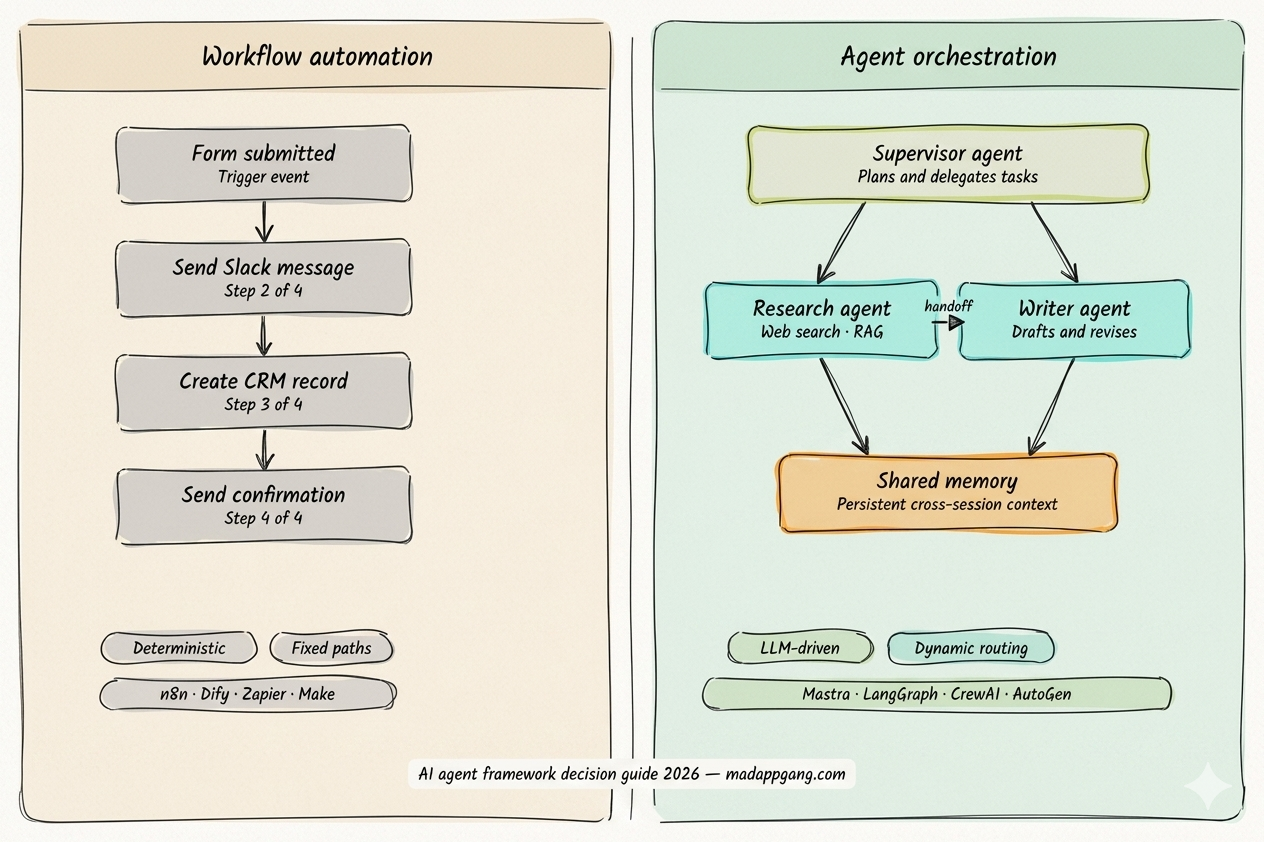
This was the first thing our team had to untangle during the research. A surprising number of tools that show up in "best agent frameworks" roundups are, under the hood, workflow engines with an LLM step added. That's not a criticism — they're excellent at what they do — but if you need true agent behavior, you'll hit their ceiling faster than you expect.
How to use this guide
The frameworks below are organized into three tiers based on how they handle agent composition.
Tier 1 — Visual team composers: Tools that let you define agent teams visually, assign tools and MCP servers to agents, and wire orchestration patterns on a canvas
Tier 2 — Visual workflow builders with agent nodes: Excellent visual builders that include agent capabilities, but treat agents as steps in a workflow rather than members of a team
Tier 3 — Code-first with monitoring UIs: The most capable orchestration engines, controlled entirely in code, with dashboards for observability and debugging
After the framework profiles, you'll find a decision matrix that maps specific team profiles to the right choice. Jump there if you're in a hurry.
Tier 1: Visual team composers
These are the tools that most closely match the "team of agents collaborating on a goal" mental model — the pattern most developers have in mind when they picture multi-agent AI.
AutoGen Studio (Microsoft)
Status: Maintenance mode since October 2025. Research prototype only.
Stack: Python/FastAPI backend, React/TypeScript frontend
License: MIT | Self-hosting: pip install only (no Docker image) | MCP: Full support
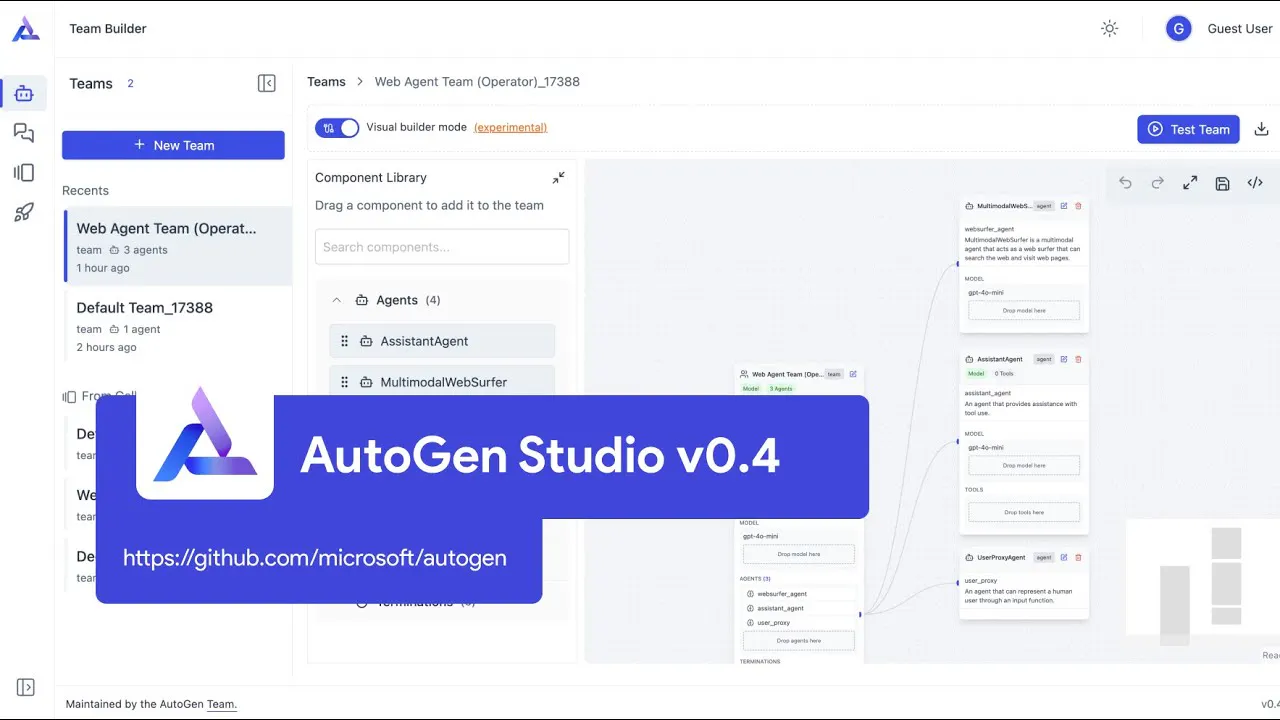 Source: microsoft.github.io
AutoGen Studio is the reference implementation for visual agent team composition. Its Team Builder provides a genuine drag-and-drop canvas — you drag agents, tools, models, and termination conditions onto a visual graph, configure them inline, and toggle to raw JSON when needed. The Playground streams real-time agent actions, shows message flow between agents, and lets you pause and redirect mid-execution.
Orchestration patterns supported include round-robin group chat, selector group chat (where an LLM picks which agent speaks next), MagenticOne (Microsoft's research pattern), and GraphFlow for directed graphs with conditional branching and loops.
Strengths:
The most complete visual agent team composition experience available in open-source
Full MCP support via
autogen_ext.tools.mcpwith both STDIO and SSE transportMultiple memory backends: ChromaDB, Redis, Mem0
Gallery system for sharing reusable component packages
Multiple database backends: SQLite, PostgreSQL, MySQL, SQL Server
Limitations:
Explicitly a research prototype — no authentication, no jailbreak protection, no per-user LLM keys
Placed in maintenance mode October 2025 — no new features, only bug fixes and security patches
Python-only backend; the React/TypeScript frontend is not meaningfully extensible
No official Docker image
Best for: Teams that want to prototype visual agent team composition and are comfortable with Python, or developers evaluating the pattern before committing to a production-ready alternative. Not recommended as the foundation of a commercial product given the maintenance status.
MadAppGang's take: AutoGen Studio's canvas is genuinely the best visual team composition experience we found in open-source. The tragedy is the maintenance status. When our team confirmed it had been placed on ice in October 2025, it immediately changed the calculus for anyone thinking about building on it long-term. Use it to understand the pattern — don't build a product on it.
Note on succession: Microsoft's new Agent Framework (MIT, public preview RC2) merges AutoGen's orchestration with Semantic Kernel's enterprise infrastructure. It supports the same orchestration patterns plus native MCP and A2A protocol support, OpenTelemetry, and Entra ID authentication. However, it has no visual studio yet — it's code-first only. A community fork called AG2 (maintained by AutoGen's original creators, ~4,000 stars, Apache 2.0) preserves the v0.2 API and adds a drag-and-drop companion called Waldiez.
Sim Studio
Status: Active development. YC W25.
Stack: TypeScript/Next.js, Bun runtime, PostgreSQL
License: Apache 2.0 | Self-hosting: Docker Compose, Kubernetes | MCP: Native
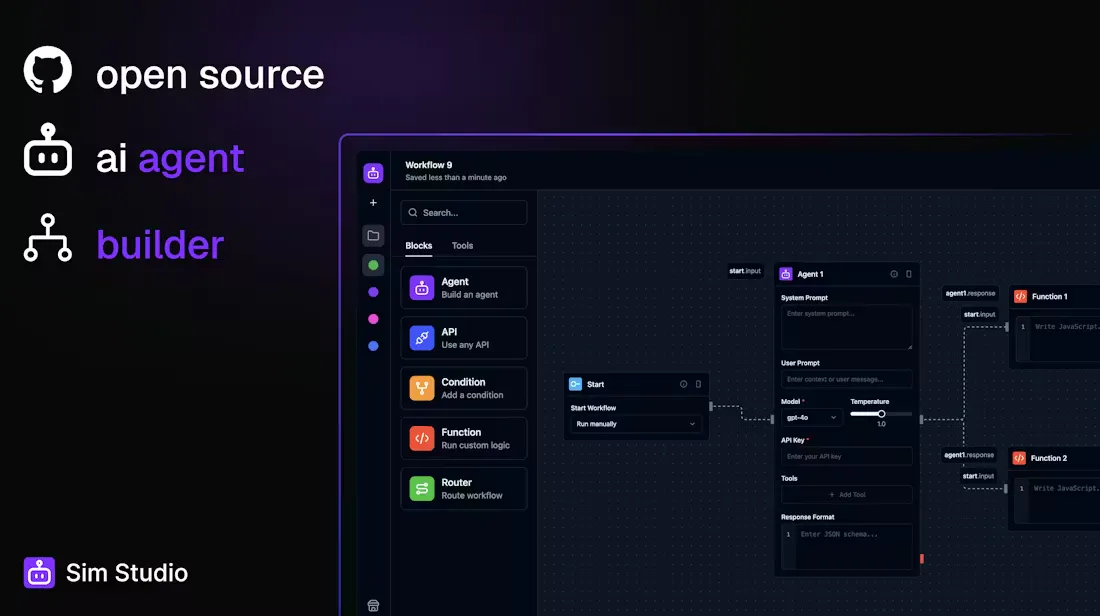 Source: producthunt.com
Sim Studio is the closest open-source equivalent to AutoGen Studio rebuilt for production use — and the only platform that checks all four boxes simultaneously: visual composition, TypeScript-native, self-hostable, and Apache 2.0 licensed.
Its canvas is Figma-like: you connect agent blocks, tool blocks, and logic blocks (routers, conditionals, loops) visually, with typed connections between nodes. MCP servers and 80+ native integrations (Slack, Gmail, Supabase, Pinecone) can be assigned directly to agent nodes. An AI "Copilot" generates workflow nodes from natural language. Run history and execution traces are built in. Ollama support enables local models.
Strengths:
The only TypeScript-native visual agent builder that is also self-hostable and Apache 2.0
Native MCP support plus 80+ integrations
Sequential, parallel, conditional, and loop orchestration patterns
PostgreSQL + Drizzle ORM + pgvector for persistence and vector search
Claims SOC2 and HIPAA compliance
Limitations:
Younger project — less battle-tested than Flowise or Langflow
Agent team composition is workflow-centric rather than role-based; there is no "role, goal, backstory" pattern equivalent to CrewAI's approach
Documentation still maturing
No built-in evaluation or testing framework
Best for: TypeScript developers who want the AutoGen Studio visual experience in a production-ready, self-hostable package. The strongest starting point for teams building commercial AI products that need visual composition without Python dependency.
MadAppGang's take: Sim Studio kept surprising us during evaluation. It's a young project, and the documentation occasionally shows it, but the canvas experience is polished in a way that newer tools rarely are. For TypeScript teams, this was the clearest answer to "I want AutoGen Studio, but production-ready and not Python."
CrewAI + Studio v2
Status: Active. Most popular multi-agent framework by community adoption.
Stack: Python only
License: MIT (core) / Commercial (Studio) | Self-hosting: On-premises with Enterprise plan | MCP: Limited (direct tool integrations for Gmail, HubSpot, Slack, Salesforce)
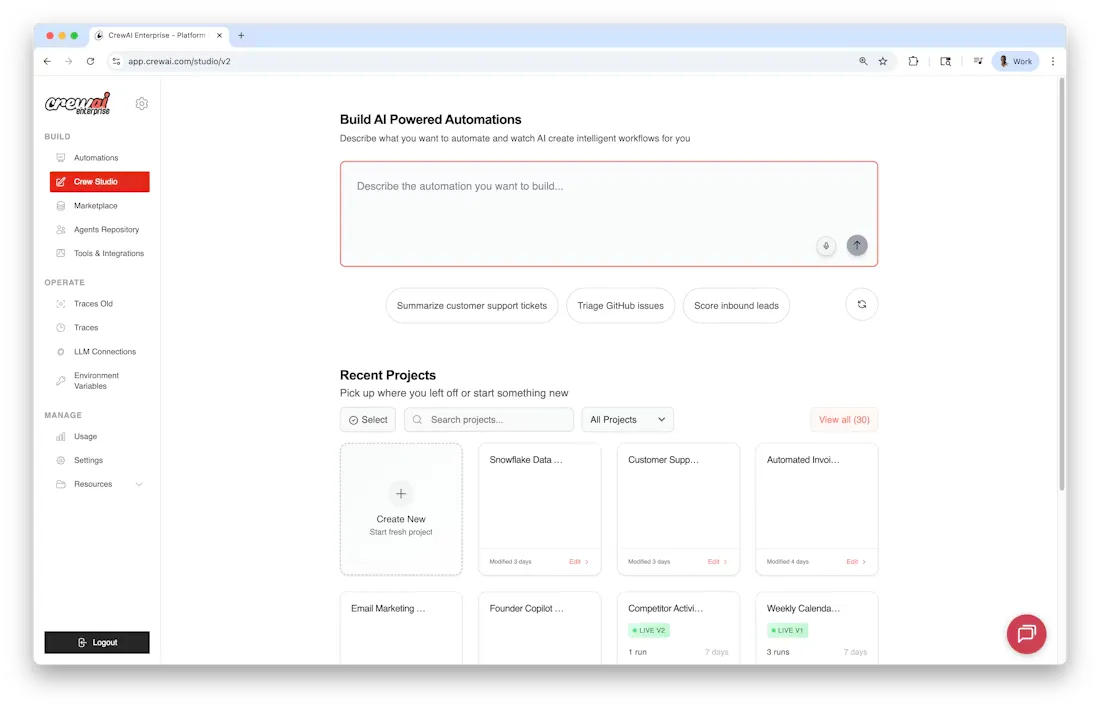 Source: crewai.com
CrewAI is purpose-built around the "crew" metaphor — agents with roles, goals, and backstories collaborating on tasks. It provides the most natural expression of "team of agents" in any framework. Enterprise customers include DocuSign, PwC, Oracle, and Deloitte.
CrewAI Studio v2 (launched May 2025) adds a full visual drag-and-drop editor with an AI copilot that generates agents, tasks, and tools from natural language, including voice input. The canvas exports to Python code. CrewAI Flows adds event-driven orchestration with conditional routing and parallel execution.
Strengths:
The richest role-based team composition experience available
4-layer memory: short-term, long-term, entity memory, and user memory (Mem0 integration)
Studio v2 AI copilot generates agents from natural language — lowest barrier to team composition
Strong enterprise track record and support
Limitations:
Studio v2 is part of CrewAI AMP — a commercial enterprise platform, not open-source. Self-hosting requires an Enterprise plan at $120,000/year for the Ultra tier
Python-only with no TypeScript support planned
No native MCP support (tools are direct integrations, not MCP-compatible)
The open-source framework has no visual builder; it's code-only
Best for: Python teams building enterprise multi-agent workflows who need the most expressive role-based composition and have budget for the commercial platform. Not viable for teams requiring TypeScript, open-source visual builders, or MCP compatibility.
MadAppGang's take: CrewAI's "role, goal, backstory" model is the most intuitive way to think about multi-agent systems we encountered — it maps cleanly to how humans describe teamwork. The licensing wall around Studio v2 was a hard stop for us. $120,000/year for the self-hosted tier puts it out of reach for most teams who aren't already committed enterprise customers. The open-source framework is solid, but you're writing Python code without a visual layer.
Tier 2: Visual workflow builders with agent nodes
These tools are genuinely excellent for a large class of problems. They're not agent orchestration in the strict sense — agents are nodes in a workflow rather than autonomous team members — but they're the right choice when the process is mostly defined and the agent layer handles specific reasoning tasks within it.
Flowise
Status: Mature. Acquired by Workday, August 2025.
Stack: TypeScript/Node.js

License: Apache 2.0 | Self-hosting: Docker, npx flowise start | MCP: Via Custom MCP Tool node (Streamable HTTP)
 Source: flowiseai.com
Flowise is the most mature TypeScript-native visual agent builder available, with 38,000+ GitHub stars and a broad deployment base. Its AgentFlow V2 (2025) introduced a native workflow engine with genuine multi-agent orchestration: Agent, Tool, Condition, Loop, and Human-in-the-Loop nodes on a visual canvas.
Built on LangChain.js and LlamaIndex, it inherits their integration ecosystems. Built-in execution traces, Prometheus/OpenTelemetry support, and human-in-the-loop checkpoints are included. Flowise 3.0 adds AI-assisted agent creation.
Strengths:
Most battle-tested TypeScript visual builder with the largest user base
Three distinct building modes: Assistant (beginner), Chatflow (single-agent RAG), AgentFlow V2 (multi-agent)
Simplest deployment path of any tool in this guide
Human-in-the-loop checkpoints built into AgentFlow V2
OpenTelemetry observability support
Limitations:
Workday acquisition raises long-term open-source direction questions
AgentFlow V2 is less mature than Dify's workflow engine for complex orchestration
Team composition is workflow-centric, not role-based
Supervisor agent pattern is not yet built-in (community-requested, not shipped)
Best for: TypeScript teams that want the most mature, widely adopted visual builder and can accept workflow-centric composition. The Workday acquisition is a real risk factor for teams making a multi-year technology bet.
MadAppGang's take: Flowise was the easiest tool in this entire evaluation to get running —
npx flowise startand you're in the canvas within two minutes. That simplicity matters more than it sounds when you're evaluating a dozen tools in parallel. Our concern is the Workday acquisition. Enterprise acquisitions of developer tools have a history of gradually prioritizing enterprise features over open-source investment. Worth watching closely over the next 12 months before committing to it as a long-term foundation.
Langflow
Status: Active. Massive community.
Stack: Python/FastAPI backend, React frontend
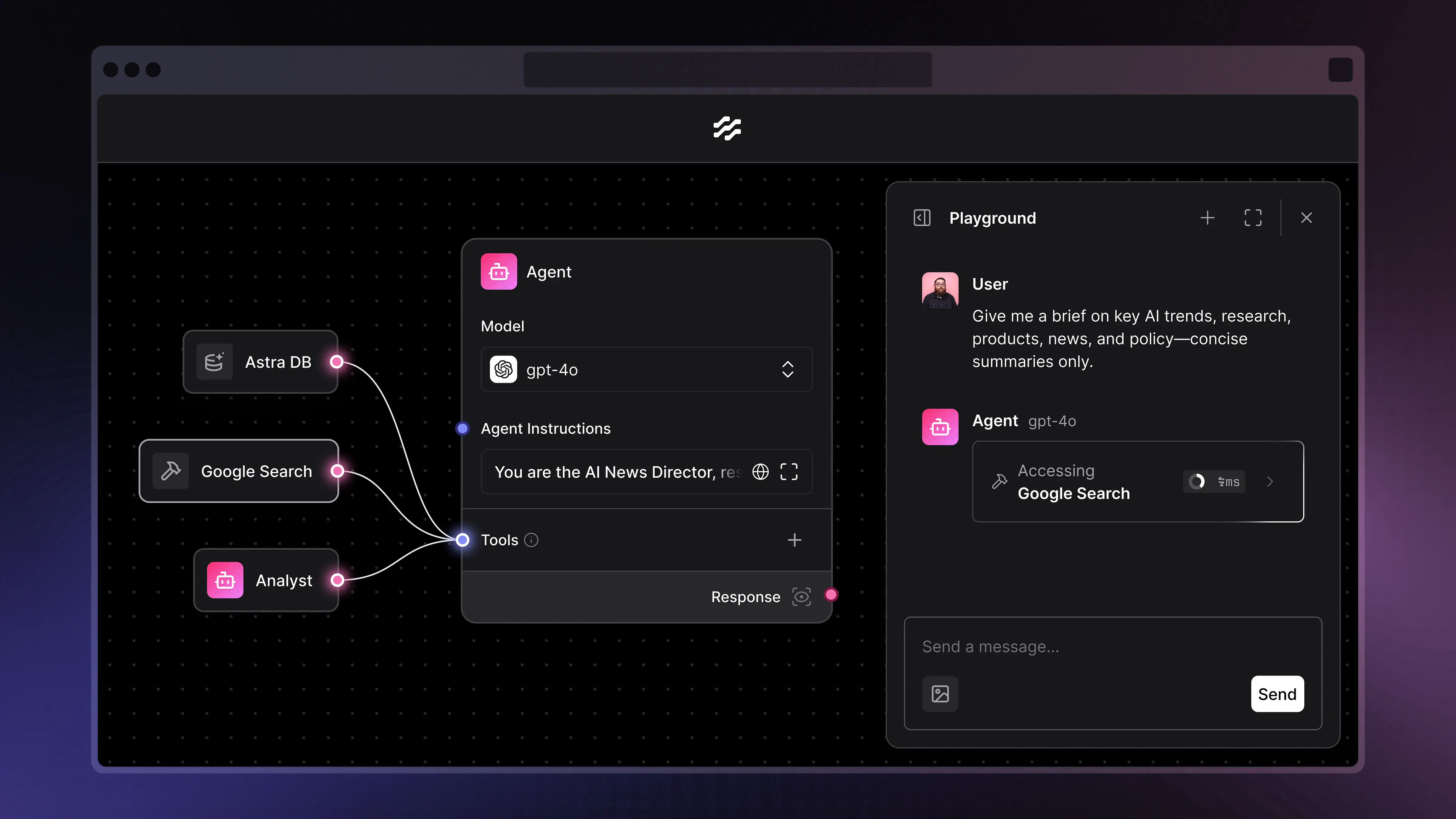
License: MIT | Self-hosting: Docker, pip install | MCP: Full + can deploy flows as MCP servers
 Source: medium.com
Langflow has the largest community of any framework in this guide with 140,000+ GitHub stars. Its visual canvas handles multi-agent workflows, RAG pipelines, and custom components. A notable differentiator: Langflow can deploy any flow as an MCP server, turning your workflow into a tool another agent can call.
Strengths:
Largest community and ecosystem in the space
Can export flows as MCP servers — strong interoperability angle
Model-agnostic with broad integration support
MIT license is genuinely permissive
Self-hostable via Docker or pip
Limitations:
Python-only backend
Multi-agent support is workflow-centric, not team-centric
No built-in observability — requires external tools like Langfuse or LangSmith
Collaboration features are weak; flows are fully isolated per user
Best for: Python teams that prioritize community size, ecosystem breadth, and MIT licensing. Strong choice for teams building workflows that need to be exposed as MCP tools to other agents.
MadAppGang's take: The MCP server export feature caught our attention — it's an elegant approach to interoperability that most tools haven't thought through. Being able to turn any workflow into a callable tool for another agent opens up composability patterns that are hard to achieve otherwise. The lack of built-in observability is a real gap though; for anything running in production, you'll be reaching for Langfuse or LangSmith regardless.
n8n
Status: Active. Most-starred tool in this guide.
Stack: TypeScript/Node.js
License: Sustainable Use (fair-code) | Self-hosting: Docker (excellent) | MCP: Full
 Source: n8n.io
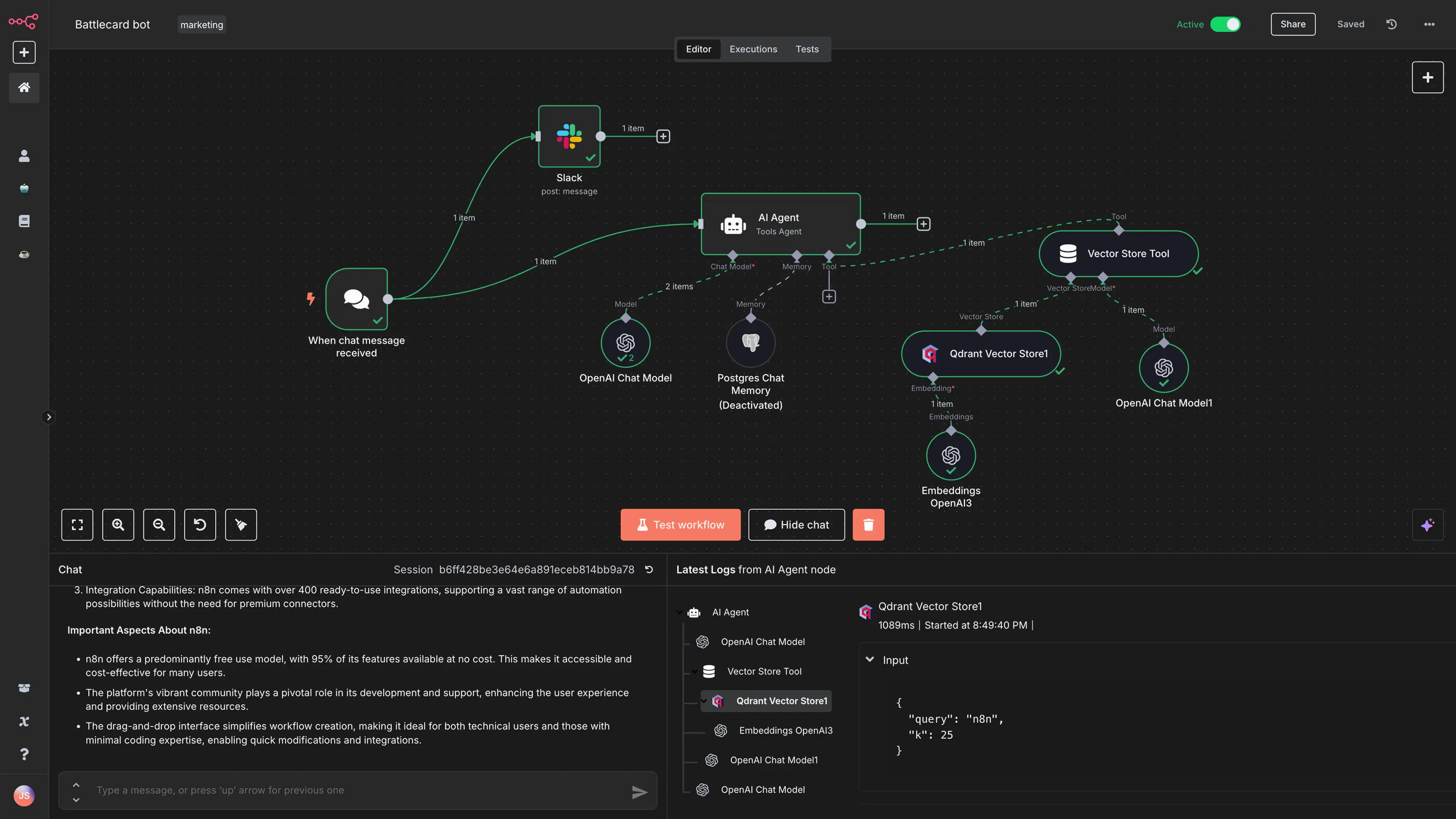
With 150,000–179,000 GitHub stars and 400+ native integrations, n8n is the most widely used tool in this comparison. Its Docker self-hosting experience is the best reference implementation in the space, often cited as the gold standard for local AI stacks (Ollama + Qdrant + PostgreSQL). AI Agent nodes support multi-agent coordination patterns.
Strengths:
Largest community and most integrations of any tool evaluated
Best Docker self-hosting experience
Full MCP support
TypeScript/Node.js stack
Limitations:
The Sustainable Use License is not true open-source — you cannot embed n8n in a SaaS product, resell automation as a service, or use it as the engine of a commercial platform without a commercial license
n8n is a general-purpose workflow automation platform; agent orchestration is one capability among many
Lacks autonomous planning, self-correction loops, and agent evaluation tooling native to true orchestration frameworks
Best for: Teams building internal automation tools, not commercial products. The license restriction is a hard stop for anyone building a product on top of n8n's engine. Excellent for DevOps workflows, internal tooling, and rapid prototyping.
MadAppGang's take: n8n's Docker self-hosting stack — Ollama + Qdrant + PostgreSQL, zero cloud spend — is the best local AI setup we came across during the research. If you're building internal tooling and don't need true agent behavior, it's an easy recommendation. The license is the stopper for commercial products. We flagged it repeatedly in our internal notes: the Sustainable Use License rules out any SaaS context, full stop.
Dify
Status: Active. Most polished visual interface in the space.
Stack: Python/Flask backend, Next.js frontend
License: Apache 2.0 with additional conditions | Self-hosting: docker compose up -d | MCP: Full bidirectional
 Source: dify.ai

Dify offers the most refined visual interface in this entire landscape — a clean dashboard with drag-and-drop workflow canvas, Prompt IDE, and distinct application modes. It supports conditional branching, parallel iteration, loops, error handling, code nodes, knowledge retrieval, and agent nodes. Its built-in LLMOps dashboard provides token tracking and cost monitoring, which is rare among visual builders.
Strengths:
Most polished visual interface and user experience
Full bidirectional MCP support
Built-in LLMOps dashboard with token tracking
Broad capability set including RAG, agents, and workflow automation
Limitations:
Despite the Apache 2.0 label, the license includes additional conditions: you cannot remove the Dify logo, and multi-tenant SaaS deployment requires written authorization from the Dify team
Agents are nodes within workflows — the "team of agents" composition pattern isn't native
Python-only backend
Best for: Teams that prioritize visual polish and built-in observability over flexibility. The license restrictions make it unsuitable for commercial products where you need to white-label the interface or build a multi-tenant SaaS.
MadAppGang's take: Dify has the most visually impressive interface we evaluated — it genuinely looks production-grade out of the box. The license is the problem. When our team read the fine print on the "Apache 2.0" claims, the additional conditions effectively rule it out for any white-labelled or multi-tenant commercial product. Worth being explicit: Apache 2.0 with logo removal restrictions is not Apache 2.0.
Tier 3: Code-first with monitoring UIs
These are the most capable and production-proven orchestration engines. You define agent logic in code; the UI layer provides observability, debugging, and testing rather than visual composition. The trade-off is a higher initial investment and a steeper learning curve — but far greater control over complex orchestration patterns.
Mastra AI
Status: Active. Post-1.0 release January 2026.
Stack: TypeScript (Bun/Node)
License: Apache 2.0 | Self-hosting: Docker | MCP: First-class (client + server, OAuth, elicitation handling, multi-registry)
 Source: mastra.ai

Mastra occupies a unique position: the only TypeScript-first agent orchestration SDK with built-in workflows, memory, MCP, and observability all in one package. Built by the team behind Gatsby.js (YC W25).
Workflows are code-defined with a chainable API: .then(), .branch(), .parallel(), .loop(), and .suspend()/.resume() for human-in-the-loop gates. A supervisor pattern lets parent agents delegate to subagents with scoring, iteration hooks, and context filtering.
The memory system is the most sophisticated of any TypeScript framework: a four-tier architecture covering message history, working memory (Zod schemas or Markdown), semantic recall (vector-based RAG), and Observational Memory — an innovative system that achieved 94.87% on the LongMemEval benchmark.
Mastra Studio provides agent testing, workflow visualization, MCP server browsing, observability traces, skills management, and working memory preview. Built-in evaluation methods cover model-graded, rule-based, and statistical approaches.
Strengths:
Only TypeScript-native framework with this combination of memory, MCP, workflows, and evals
Four-tier memory with industry-leading benchmark performance (94.87% LongMemEval)
First-class MCP with OAuth, elicitation handling, and multi-registry support
Human-in-the-loop via
.suspend()/.resume()— one of only three frameworks with native supportBuilt-in evaluation framework — rare across all frameworks evaluated
Limitations:
No drag-and-drop visual builder; Studio visualizes execution but does not build workflows visually
API surface was still shifting rapidly post-1.0 at time of this report
Enterprise RBAC features require a commercial license
Younger ecosystem than Python alternatives
Best for: TypeScript developers who need production-grade orchestration, sophisticated memory, and strong MCP integration, and who are comfortable defining agent logic in code. The gold standard for TypeScript agent SDKs; the gap is the visual composition layer.
MadAppGang's take: Mastra was the framework that most impressed our engineers during evaluation — not for any single feature, but for the combination. Four-tier memory, first-class MCP,
.suspend()/.resume()for human-in-the-loop, and built-in evals in one TypeScript package is genuinely rare.
LangGraph Platform + Studio
Status: GA (Platform), active (Studio). Stack: Python (primary), JavaScript/TypeScript (beta) License: MIT (library) / Proprietary (platform) | Self-hosting: Limited (Enterprise required for full self-hosting) | MCP: Native since v1.0 (October 2025)
 Source: langchain.com
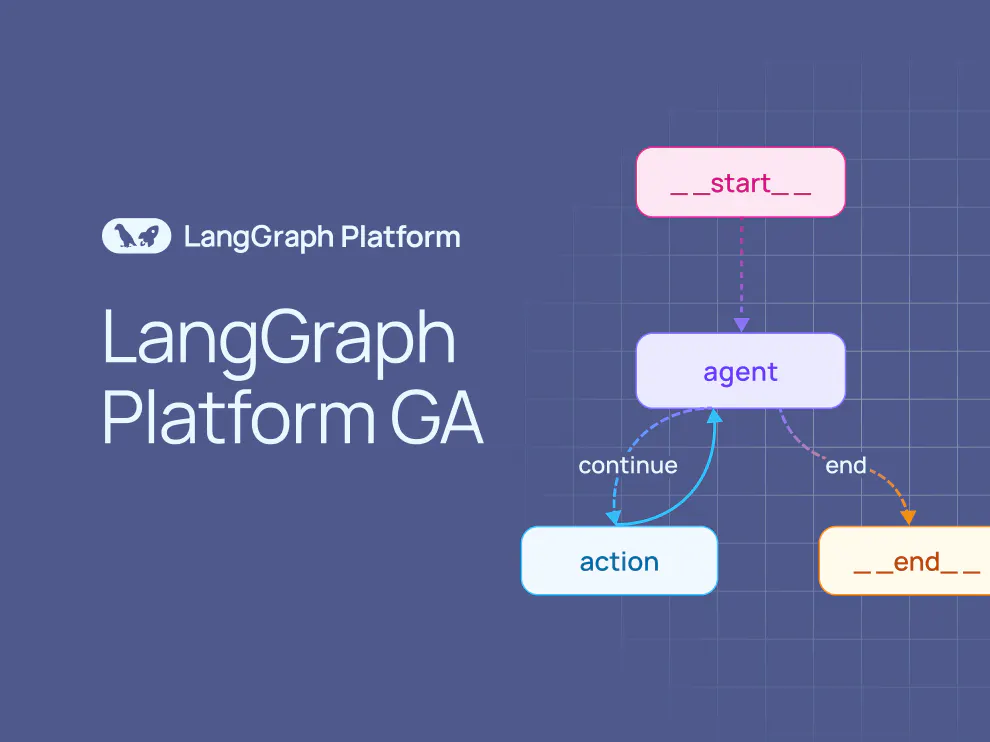
LangGraph is the most production-proven and flexible agent orchestration framework available. Its directed graph model — nodes as functions, edges as transitions, conditional routing, cycles for loops, subgraphs for hierarchical agents — supports any orchestration pattern you can design.
LangGraph Studio provides real-time graph visualization, state editing, time-travel debugging, interrupt before tool calls, and evaluation running. The platform offers 30+ API endpoints for streaming, human-in-the-loop, checkpointing, cron scheduling, and durable execution with automatic retry and recovery.
Strengths:
- Most flexible graph topology of any framework — arbitrary sequential, parallel, loops, conditional branching, hierarchical subgraphs
- Time-travel debugging is the most-envied debugging feature in the space
- Strong persistence via reducer-driven shared state and Store API for cross-session memory
- Durable execution with automatic retry and recovery
- Native MCP support
Limitations:
- LangGraph.js is second-class — Studio support is in beta, TypeScript SDK lags Python significantly in features
- Full self-hosting requires an Enterprise contract; the free Self-Hosted Lite tier caps at 100,000 node executions per month
- Platform charges $0.001 per node execution on paid tiers
- Studio is a debugging and inspection tool, not a visual workflow builder — you write code, Studio renders it
- Commonly cited 1–2 week ramp-up for new developers; steep learning curve
Best for: Python teams building complex, production-critical multi-agent systems where maximum orchestration flexibility and time-travel debugging are worth the learning curve and licensing constraints. Not the right choice for TypeScript teams or organizations that need true open-source self-hosting.
MadAppGang's take: LangGraph is the framework our Python engineers consistently reached for when orchestration complexity got serious. The time-travel debugging alone is worth the learning curve — being able to rewind execution state and replay from any point is something you don't know you need until you've spent an afternoon trying to reproduce a multi-agent failure. The self-hosting story is the sticking point: the free tier caps at 100,000 node executions per month, and full self-hosting requires an Enterprise contract. For TypeScript teams, the JS SDK is genuinely second-class — don't let the beta label fool you into thinking it's close to parity.
Letta ADE (formerly MemGPT)
Status: Active. Stack: Python server, TypeScript and Python client SDKs License: Apache 2.0 | Self-hosting: Docker | MCP: Native
 Source: letta.com
Letta has the most sophisticated memory architecture of any framework in this guide. It evolved from the MemGPT research project into a full stateful agent platform. The four-tier memory model includes core memory (always in-context, self-editable by the agent), recall memory (full conversation history, searchable), archival memory (vector DB-backed knowledge), and a filesystem interface for documents. All memory is backed in PostgreSQL with no serialization overhead.
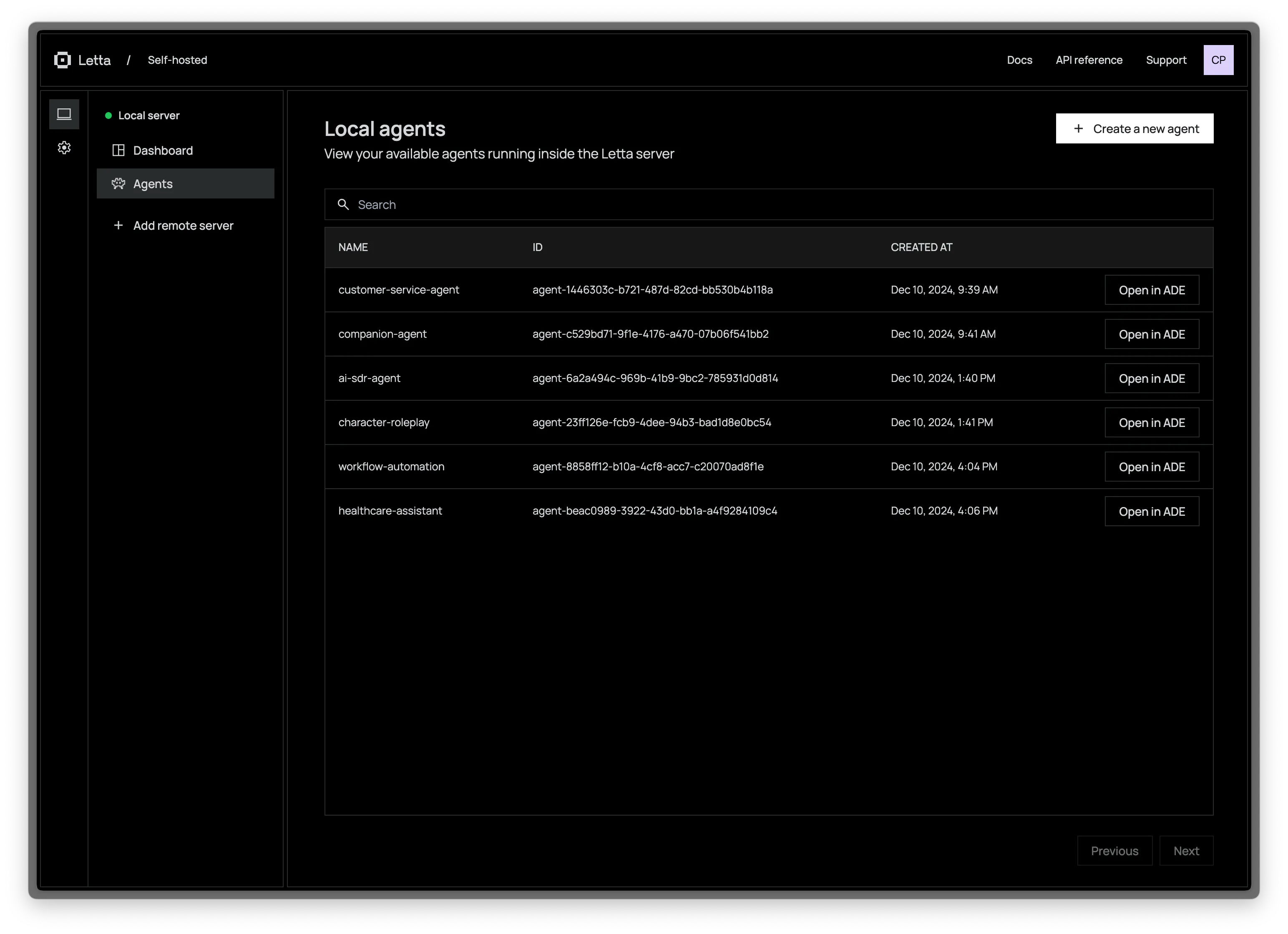
The Agent Development Environment (ADE) provides a web and desktop UI for creating agents, inspecting context windows, editing core memory blocks, browsing archival memory, managing tools, and running agent simulators.
Strengths:
- Best-in-class persistent memory architecture — unmatched in the space
- All memory database-backed in PostgreSQL with direct access (no serialization)
- Multi-agent communication via async message-passing
- ADE provides deep introspection into agent memory state
Limitations:
- Primarily a stateful single-agent framework growing into multi-agent territory; complex delegation loops are far less developed than Mastra or LangGraph
- Python server (TypeScript SDK provides client access only, not server-side orchestration)
- ADE is for development and testing, not team composition or workflow building
Best for: Teams where persistent, accurate cross-session memory is the primary requirement — conversational agents, long-running research assistants, or any application where the agent must maintain reliable context across many sessions.
MadAppGang's take: If persistent memory is your primary requirement, nothing else in this guide comes close. The four-tier architecture — core memory that the agent can edit itself, recall memory across sessions, archival memory backed by vector search, all sitting on PostgreSQL with no serialization overhead — is a genuinely different approach to the problem. Where we'd pump the brakes is on multi-agent orchestration: Letta is still primarily a stateful single-agent framework. If you need complex delegation patterns or supervisor loops, you'll be working against the grain rather than with it.
Google ADK
Status: Apache 2.0, active, multi-language. Visual builder is experimental. Stack: Python (primary), TypeScript/JS, Go, Java License: Apache 2.0 | Self-hosting: Anywhere | MCP: Native + A2A (Agent-to-Agent) protocol
 Source: adk.dev
Google's Agent Development Kit launched in April 2025 and is the most feature-complete new entrant with genuine multi-language support. It provides purpose-built agent types: LLMAgent for open-ended reasoning, SequentialAgent, ParallelAgent, and LoopAgent as composable primitives. Hierarchical multi-agent systems are supported natively — agents call other agents as tools.
An experimental Visual Builder (ADK Python v1.18.0, November 2025) adds drag-and-drop composition with an AI assistant that generates configs from natural language.
Strengths:
- Only framework in this guide with first-class support for Python, TypeScript/JS, Go, and Java
- Native A2A (Agent-to-Agent) protocol for cross-framework interoperability
- Apache 2.0 license with no additional conditions
SequentialAgent,ParallelAgent, andLoopAgentas first-class primitives- Lightweight dev UI via
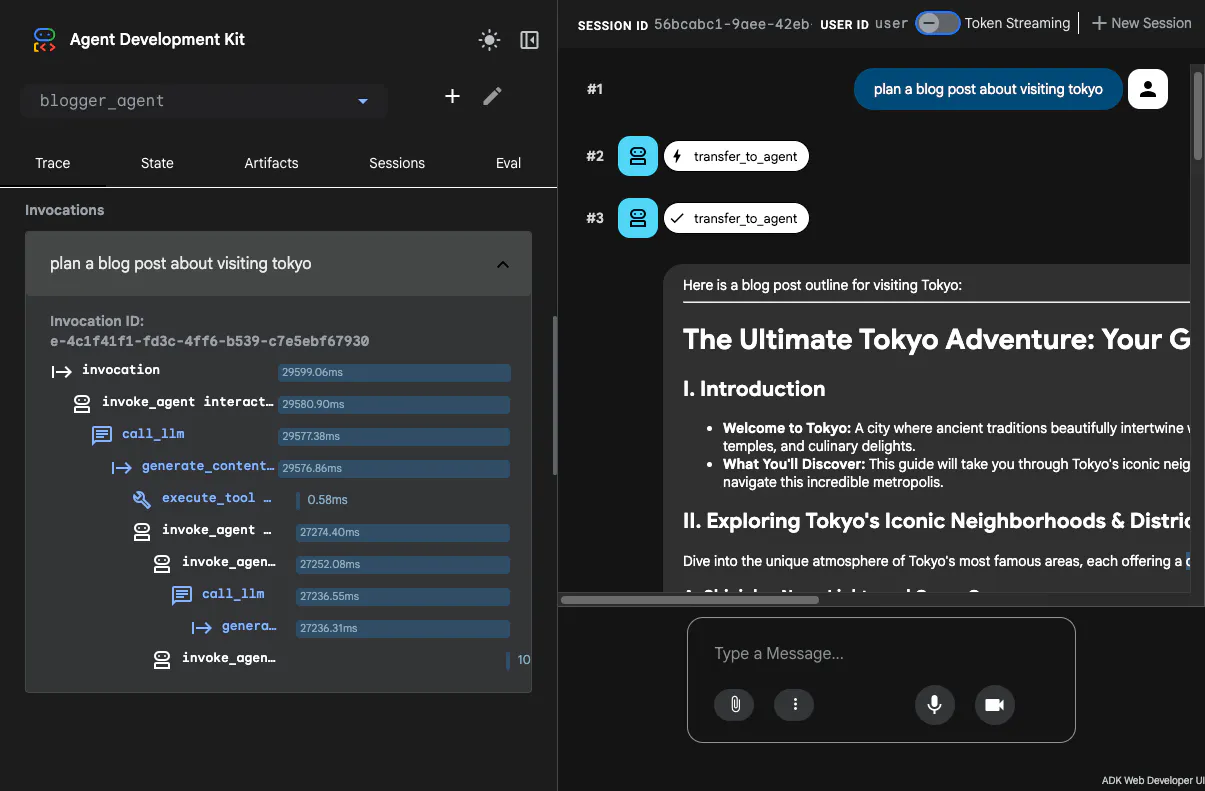
adk webfor testing
Limitations:
- Visual Builder is experimental — not production-ready; MCP tools not yet supported in the visual dropdown
- Optimized for Gemini models (model-agnostic via LiteLLM, but Gemini clearly preferred)
- TypeScript SDK is newer and less battle-tested than the Python version
- No built-in persistent memory — requires external stores
- Deployment documentation leans heavily on GCP
Best for: Polyglot engineering teams, or teams already in the Google/GCP ecosystem. The A2A protocol support makes it a strong choice for organizations building agents that need to interoperate across frameworks.
MadAppGang's take: The multi-language support is the story here. Python, TypeScript, Go, and Java with proper first-class support — not afterthoughts — is something no other framework offers. For polyglot teams or organizations that can't standardize on one backend language, that matters more than any individual feature. The Gemini preference is real though; the framework is model-agnostic in theory, but in practice the documentation, examples, and defaults all point toward GCP. The experimental visual builder is promising but not production-ready — we'd treat it as something to watch in the second half of 2026 rather than something to build on today.
KaibanJS
Status: Active. Stack: JavaScript/TypeScript License: MIT | Self-hosting: npm | MCP: Via LangChain adapter
 Source: kaibanjs.com

KaibanJS is the only significant JavaScript-native multi-agent framework with a team metaphor. It uses a Kanban-inspired approach where agent tasks move through states like cards on a board. Agents are defined with role, goal, and background (similar to CrewAI but in JavaScript). The Kaiban Board visualizes task execution like a Trello board. OpenTelemetry observability is built in, and it works in both Node.js and browser environments.
Strengths:
- Only JavaScript-native multi-agent framework with a CrewAI-like role-based model
- Browser-compatible — can run agent logic client-side
- OpenTelemetry observability built in
Limitations:
- Small community (1,400 stars) with limited ecosystem support
- The Kaiban Board is a monitoring tool, not a drag-and-drop builder
- Teams are defined in code, not visually composed
- Memory and persistence are basic
- Less mature orchestration patterns than Mastra or LangGraph
Best for: JavaScript teams (not TypeScript-first) who want a CrewAI-like role metaphor without a Python dependency, and who have modest orchestration complexity requirements. The small star count is a risk signal worth checking before committing.
MadAppGang's take: KaibanJS fills a specific gap — CrewAI's role-based team metaphor, but in JavaScript without a Python server anywhere in the stack. For browser-based agent logic or JS-first teams that find TypeScript overhead unnecessary, it's a credible option. The honest constraint is community size: 1,400 stars means a small ecosystem, limited third-party integrations, and slower bug resolution. We'd want to see the project grow significantly before building anything business-critical on it. Check the commit velocity before committing.
Rivet
Status: Active (v1.11.3, August 2025). Stack: TypeScript (Tauri/Rust desktop app + web frontend) License: Open source | Self-hosting: Desktop app | MCP: Three dedicated MCP node types
 Source: rivet.dev
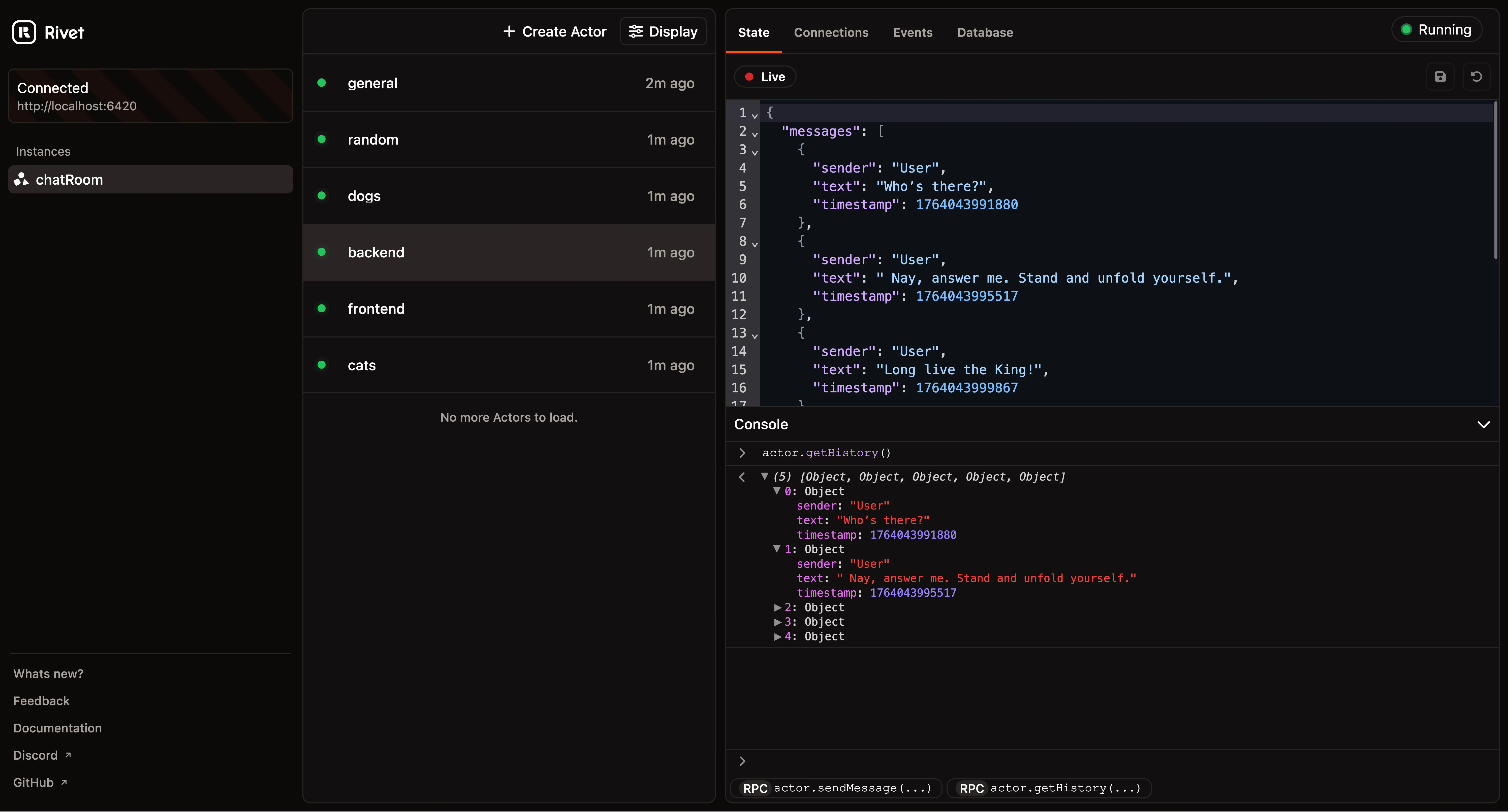
Rivet is architecturally different from every other tool in this guide. It's a visual-first IDE for building prompt chains and agent logic — not a code-first SDK with a UI added on top. Graphs are built in a Tauri desktop application using nodes (Text, Chat, Prompt, Loop Controller, If/Conditional, HTTP, Code) and saved to YAML for Git version control. Execution happens via @ironclad/rivet-core or @ironclad/rivet-node.
Strengths:
- Only tool in this guide that is genuinely visual-first — the graph is the primary artifact, not the code
- YAML output is Git-version-controllable
- Three dedicated MCP node types (Discovery, Tool Call, Get Prompt)
- Pure TypeScript execution runtime
- AI-assisted graph generation via CMD+I
Limitations:
- No built-in memory or state persistence
- Multi-agent orchestration is indirect through graph composition, not first-class supervisor/worker primitives
- No deployment platform — graphs run embedded in your application
- Desktop app only; no web-based collaboration
- No built-in evaluation or observability framework
Best for: TypeScript developers who want to design prompt chains and agent logic visually and embed them in their own applications. Strongest fit for teams that think in graphs and want Git-trackable artifacts, but need to handle persistence and deployment independently.
MadAppGang's take: Rivet is the odd one out in this tier — and that's not a criticism. It's the only tool in this entire guide where the graph is the primary artifact rather than the code. For teams that think visually and want their prompt chains under Git version control, that's a meaningful architectural difference. The gaps are real though: no built-in memory, no deployment platform, desktop-only. You're essentially getting a very good visual IDE for designing agent logic that you then have to wire into your own infrastructure. If your team is comfortable owning that plumbing, Rivet earns its place.
Tools to approach with caution
Several tools in this space carry significant risks that disqualify them for new commercial projects:
AgentGPT was archived in January 2026 and is no longer maintained.
Superagent completely pivoted to an AI safety/security SDK. The original agent builder platform is gone.
Relevance AI provides arguably the best proprietary visual team builder available (Workforce Canvas, $37M raised, 40,000+ agents deployed) — but it is cloud-only SaaS with no self-hosting, no open-source option, and no MCP support.
AutoGPT Platform carries a Polyform Shield license that prohibits competitive commercial use. It is not truly open-source.
n8n has a Sustainable Use License that prevents embedding in commercial SaaS products.
Dify carries Apache 2.0 with additional restrictions on logo removal and multi-tenant SaaS deployment.
Framework decision matrix
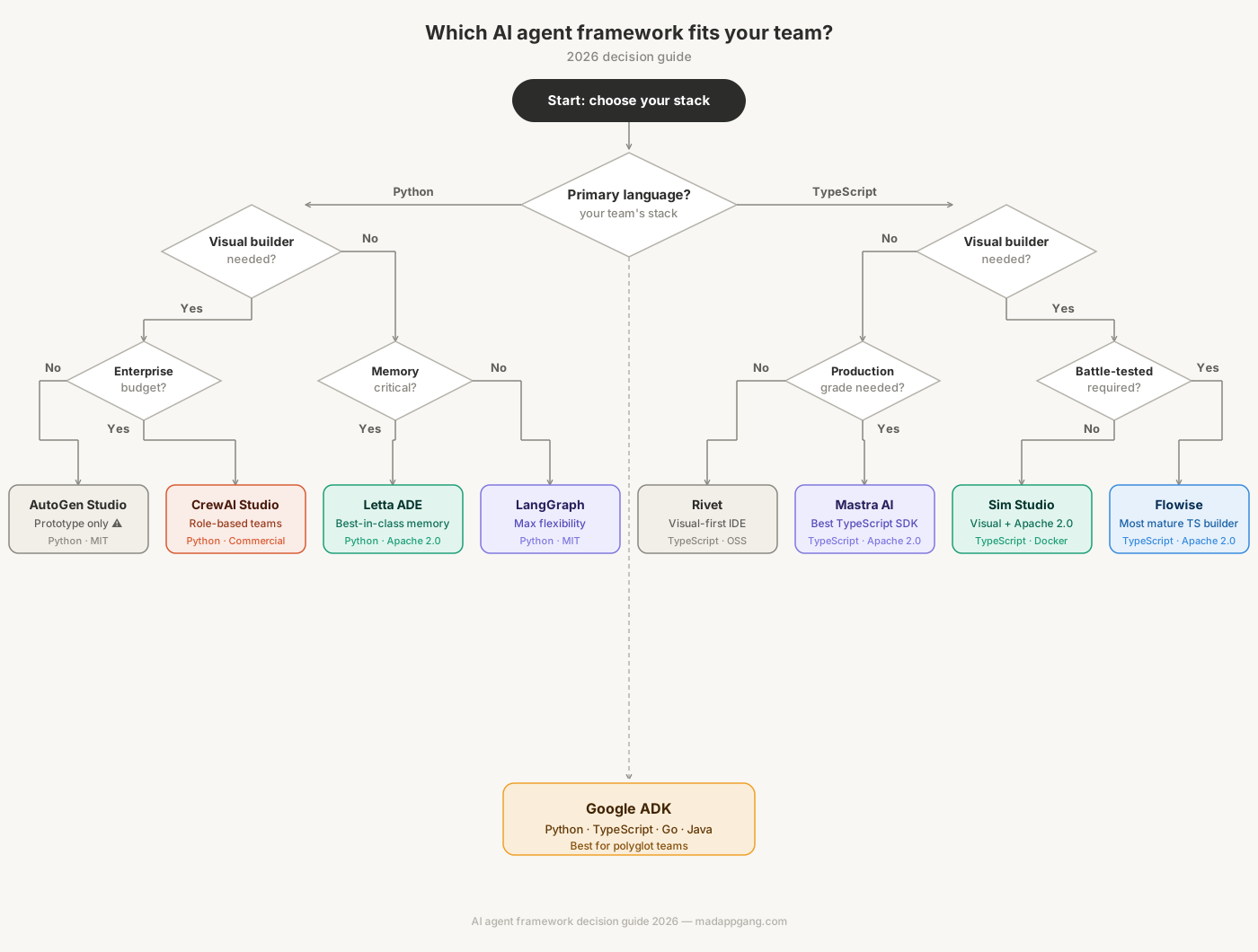
Use this matrix to find your best-fit framework based on your team's primary constraints.
| Team profile | Primary need | Recommended framework | Second choice |
|---|---|---|---|
| TypeScript dev, visual builder | Visual composition + TypeScript | Sim Studio | Flowise (AgentFlow V2) |
| TypeScript dev, code-first | Production orchestration + memory | Mastra AI | LangGraph (JS beta) |
| Python team, max flexibility | Complex graph topologies | LangGraph | Google ADK |
| Python team, team metaphor | Role-based agents, enterprise | CrewAI (with budget for Studio) | AutoGen Studio (prototype only) |
| Enterprise, data sovereignty | Self-hosted, compliant, TypeScript | Sim Studio + Mastra | Flowise |
| Persistent memory is critical | Long-running stateful agents | Letta ADE | Mastra AI |
| Polyglot team / multi-language | Python + TypeScript + Go/Java | Google ADK | Mastra (TS) + LangGraph (Python) |
| Visual-first, TypeScript IDE | Graph-based prompt/agent design | Rivet | Sim Studio |
| Internal automation (not SaaS) | Integrations + workflow + agents | n8n | Dify |
| JavaScript (not TS), team metaphor | CrewAI-like in pure JS | KaibanJS | Mastra AI |
| Largest community, MIT license | Ecosystem size + visual builder | Langflow | Flowise |
Comprehensive Comparison Matrix
Primary Comparison: Visual Agent Orchestration
| Platform | Visual Teams | TypeScript | Self-Host | MCP | Memory | License | GitHub Stars | Production Ready |
|---|---|---|---|---|---|---|---|---|
| Sim Studio | ✅ Full canvas | ✅ Next.js/TS | ✅ Docker/K8s | ✅ Native | PostgreSQL + pgvector | Apache 2.0 | 21.8K | High |
| Flowise | ✅ AgentFlow V2 | ✅ Node/TS | ✅ Docker | ✅ MCP node | LangChain memory | Apache 2.0 | 38K+ | High* |
| Langflow | ✅ Multi-agent canvas | ❌ Python | ✅ Docker | ✅ + MCP server export | External | MIT | 140K | High |
| AutoGen Studio | ✅ Team Builder | ❌ Python | ⚠️ Pip only | ✅ Full | ChromaDB/Redis/Mem0 | MIT | 55K | ⚠️ Research only |
| CrewAI Studio | ✅ Full + AI copilot | ❌ Python | ✅ On-prem (paid) | ⚠️ Limited | 4-layer + Mem0 | Mixed | 44K | High (paid) |
| Dify | ⚠️ Workflow nodes | ❌ Python | ✅ Docker | ✅ Full bidirectional | RAG + conversation | Apache 2.0* | 114K+ | High |
| n8n | ⚠️ Automation | ✅ Node/TS | ✅ Docker | ✅ Full | External DB required | Fair-code | 150K+ | High |
| Mastra AI | ⚠️ Monitor only | ✅ Native TS | ✅ Docker | ✅ Full (client+server) | 4-tier + Observational | Apache 2.0 | 22K | High |
| Google ADK | ⚠️ Experimental | ✅ JS/TS version | ✅ Anywhere | ✅ + A2A | External only | Apache 2.0 | New | ⚠️ Experimental |
| KaibanJS | ⚠️ Kanban board | ✅ Native JS/TS | ✅ NPM | ✅ via LangChain | Basic | MIT | 1.4K | Moderate |
| LangGraph | ⚠️ Studio (debug) | ⚠️ Beta JS | ⚠️ Enterprise | ✅ Native | Checkpointing + Store | MIT lib | 26K | High (Python) |
| Letta ADE | ⚠️ Dev/test | ❌ Python server | ✅ Docker | ✅ Native | Best-in-class 4-tier | Apache 2.0 | 21K | High |
| Rivet | ✅ Node-based IDE | ✅ Pure TS | ✅ Desktop | ✅ 3 MCP nodes | None built-in | Open source | 4.5K | Moderate |
| Agno | ⚠️ AgentOS monitor | ❌ Python | ✅ Docker | ✅ Native | PostgreSQL | Apache 2.0 | 38.7K | High |
| Relevance AI | ✅ Workforce Canvas | ❌ Proprietary | ❌ Cloud-only | ❌ None | Platform-managed | Proprietary | N/A | High (SaaS) |
* Dify Apache 2.0 includes additional conditions. Flowise acquired by Workday — OSS future uncertain.
Key for Symbols
| Symbol | Meaning |
|---|---|
| ✅ | Full support / native capability |
| ⚠️ | Partial, limited, or conditional support |
| ❌ | Not supported / not available |
The recommended hybrid architecture
For a TypeScript-first team wanting both visual composition and production-grade orchestration, no single framework does everything today. The combination that covers the most ground:
| Layer | Tool | Role |
|---|---|---|
| Visual composition | Sim Studio | Drag-and-drop agent/workflow composition, MCP management, run visualization |
| Orchestration engine | Mastra AI SDK | Code-defined agent logic, supervisor patterns, delegation, loops, 4-tier memory |
| Observability | Langfuse (open-source) | Tracing, cost attribution, evaluation — integrates with both |
This stack covers 13 of the 15 most-demanded developer features identified in our research, while remaining fully TypeScript-native, self-hostable, and Apache 2.0 / MIT licensed.
Frameworks to watch in 2026
The landscape is moving fast. These tools could shift the rankings within the next 6–12 months:
Microsoft Agent Framework — If Microsoft ships a visual studio comparable to AutoGen Studio, it could be the dominant enterprise option. Currently code-first only, Python/.NET, no TypeScript. Monitor: github.com/microsoft/agent-framework
Google ADK Visual Builder — The experimental visual builder (November 2025) has TypeScript support, Apache 2.0 licensing, and the backing of Google's infrastructure. If it reaches production-ready status, it becomes a strong contender for enterprise teams in the GCP ecosystem.
Sim Studio — At 21,800+ GitHub stars and growing, this YC W25 company is the fastest-moving TypeScript-native tool in the space. If they add role-based team composition and deeper memory architecture, it could become the definitive platform for the audience currently underserved by Python-centric tools.
AG2 + Waldiez — The community fork of AutoGen with a drag-and-drop visual companion. Python-only, but actively developed (v0.11.2, February 2026) with A2A protocol support. A viable path for teams that built on AutoGen v0.2 and need a maintained fork.
Conclusion
After evaluating more than 20 frameworks across nine dimensions, our conclusion is this: the exact tool most development teams are looking for — visual team composition, TypeScript-native, self-hostable, production-grade memory and observability — does not exist as a single integrated platform in 2026. That gap is real, well-documented, and not close to being filled.
What we found instead is a landscape of strong partial solutions. Sim Studio comes closest to the visual composition experience teams want. Mastra AI has the strongest TypeScript SDK by a significant margin. LangGraph has the deepest orchestration capabilities and the best debugging story. CrewAI has the richest team metaphor. None of them does everything.
The differentiator that separates serious production frameworks from prototypes isn't the number of integrations or the visual polish of the canvas — it's how a framework models time, memory, and failure. Most tools in this space are still figuring that out. Choose based on your team's language, your orchestration complexity, and your licensing constraints. Then revisit in six months. This landscape is moving fast enough that the second choice today may be the first choice by year-end.

