Kanban is for people. The agent outgrew it

CTO of MadAppGang
You give the agent ten steps. It does two and stops.
That was the whole problem back then. Not hallucinations, not bad code. The model would read a clear plan, work through the first couple of items, write a confident summary, and stop. The summary was the worst part. It sounded finished. You had to open the diff to find out that steps three through ten never happened.
This week we deprecated the two plugins we built to fix that. GTD and Kanban. They were the first plugins ever written for Magus.
Let me explain why they existed, and why they don't need to anymore.
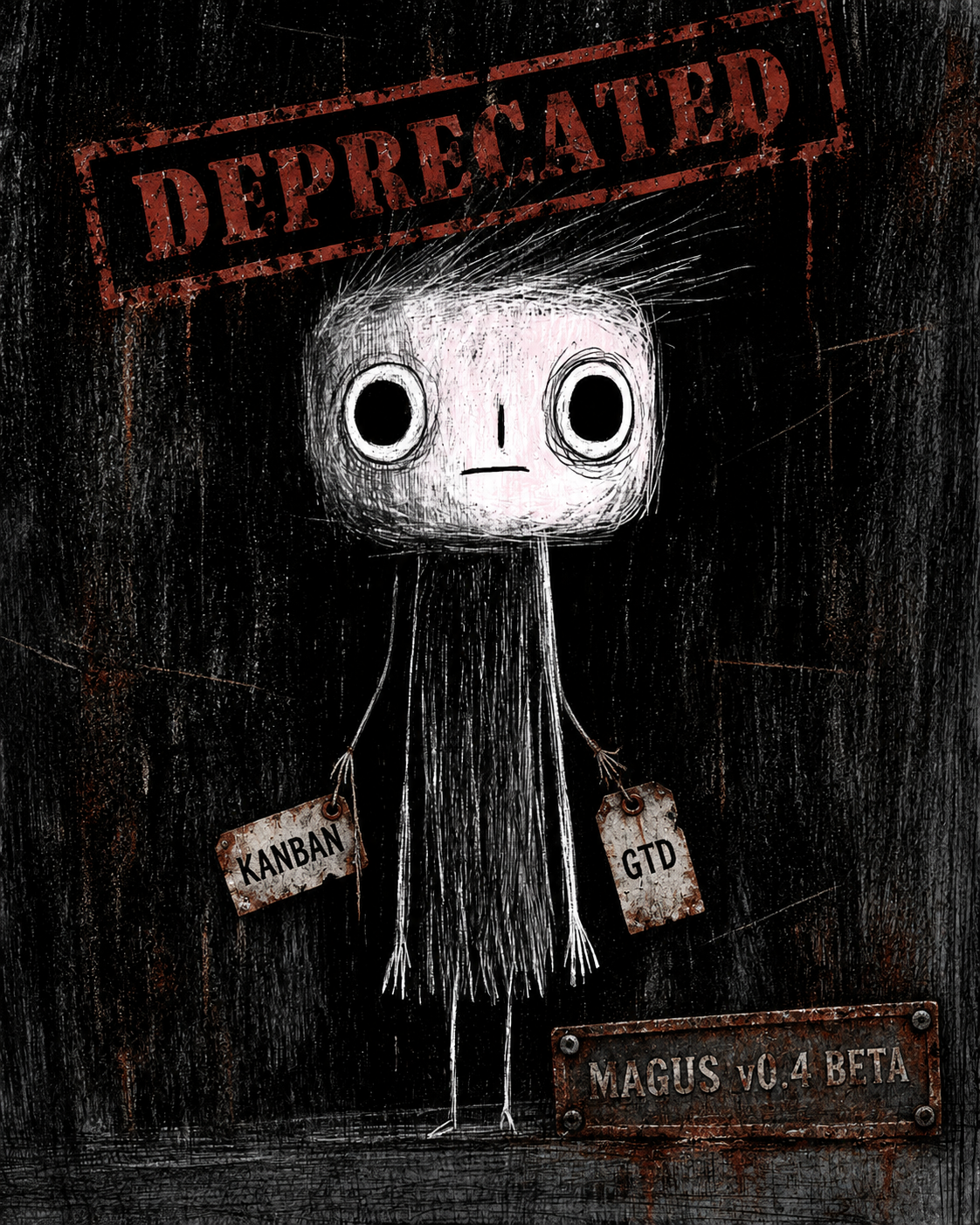
The first two Magus plugins. They did their job, then they didn't.
The board was never for us
We built them in the age of Sonnet 3.5. That model was good. It could write a plan that a senior engineer would sign off on. It just could not walk its own plan to the end.
So we shipped a to-do plugin and a Kanban plugin. On the surface, project management tools. They were not. Nobody on my team ever opened those boards to check on anything.
The board was memory for the agent.
The mechanism is simple once you see it. A model works inside a context window. On a long task, the early part of the conversation gets pushed out or drowned out, and the plan goes with it. So we wrote the plan into a file instead. A file survives outside the context window. Every turn, the agent re-read the board and got its own intentions back.
Think of it like a shopping list. You write it not because you don't know what you need. You write it because by aisle four you won't.
Re-reading was not enough
Here is the part people miss. Giving the model a list did not fix the model.
It still stopped. It would re-read the ten items, do two more, and declare victory again. The list made it slightly more honest about what it had planned, and not at all more likely to finish.
So we added a hook. Before the agent was allowed to end its turn, it got a question. Here are the open items. Are they all done? If not, keep going.
That was it. Automated nagging. Don't tell the agile coaches, they do exactly the same thing and call it a ceremony.
And it worked. With the board plus the hook, ten-step tasks actually finished ten steps. Without it, we were getting two or three. That gap was the entire reason those two plugins existed.
Then the models grew up
I don't have a dramatic moment for this. There was no day when it flipped. We just kept running the same kinds of tasks, and at some point the harness stopped mattering.
The test that settled it for me was Haiku. Haiku is the small one. It's old now, it's the cheapest thing in the lineup, and it is nobody's idea of a reasoning model. We gave it a long plan with no board, no hook, no nagging.
It finished the list.
That's when I knew the plugins were done. Not when Opus could do it. When the least capable model in the family could do it.
Long-horizon work moved from a thing you had to engineer around to a thing the model just does. Almost every top model handles it now. It stopped being our problem and became theirs, which is where it belonged in the first place.
Two honest exceptions
Gemini still struggles with this. On long-horizon tasks it drifts in a way the others don't anymore. I'm not going to pretend otherwise to make my point cleaner.
And small local models are exactly where Sonnet 3.5 was. Run a 27B or a 40B, give it ten steps, and you will get two. Those models need the list, they need the board, and they need something nagging them through it. If you're building a framework for local inference, keep your Kanban. You still live in 2024, and that is not an insult, it is just the hardware you chose.
"Then why kill it, Jack?"
You'll ask me that, and it's a fair question. Two exceptions is not zero. Why not keep the plugins around for the cases where they still help?
Because Magus was never meant to be a general engineering framework. It's built for the top models. That's the whole design decision, and every other decision follows from it.
Scaffolding that does nothing is not free. Someone maintains it. It loads into context and spends tokens. Worse, it spends the model's attention on a bookkeeping ritual instead of the actual work. A plugin that made the agent better in 2024 and does nothing in 2026 is not neutral. It's a small tax on every single run.
So we deleted it. If you need that behaviour for a local model, the code is there, fork it. It's not coming back to the default set.
We still need the board. For a completely different reason.
This is the part I want to be careful about, because it's easy to read all of the above as "Kanban is dead". It isn't.
The agent needed a board because it forgot. We need a board because we can't see inside each other's heads.
Those are not the same need at all. A team board is not a memory device. It's a shared picture. Who is on what. What's blocked and who is blocking it. What comes after this thing lands. What got quietly dropped last week and nobody said so. No model gives you that, and asking six people in Slack doesn't either.
I still keep a board. Not because I forget what I'm doing. Because on Friday someone asks, and "a lot of things" is not an answer.
So the board didn't die. It changed owner. It went back to the people who actually needed it, and stopped being a crutch we bolted onto a machine.
What this actually tells us about Magus
Deprecating two plugins is a small thing. What it says is not.
Magus exists because models have limits. Every single piece of it is a workaround for something the model can't do well enough yet. Plan across a long horizon. Hold facts across sessions. Drive a terminal. Check its own work before claiming it's done. Pick the right file out of a big repo.
A harness is a list of the model's current weaknesses, written as code.
Read that sentence again and the consequence is obvious. The list changes every few months. The code doesn't change itself.
We wrote GTD and Kanban for a weakness that no longer exists. Something in the current Magus is in the same position right now and I probably can't tell you which part. I'll find out the same way I found out this time. By turning it off and seeing that nothing breaks.
So here is my honest forecast. In a year Magus will be a different product, or it will not exist. Both outcomes are fine. Scaffolding comes down when the building stands. That's not a failure of the scaffolding, it's the point of it.
What I'm less relaxed about is the industry habit of treating harnesses as permanent architecture. People are writing frameworks, selling courses, building companies on workarounds for behaviours that a model release quietly deletes. Every week there's a tool that changes everything. By Friday the model update changed it back.
The discipline is not building the scaffolding. Anyone can build scaffolding. The discipline is checking, on a schedule, whether you still need it.
Two plugins had about a year of real, useful life. For this kind of software, that's a long run. They pushed a young model through work it couldn't finish on its own, and then the model grew up and didn't need the push.
I'd call that a successful product. It worked, and then it became unnecessary. In this field those are the same sentence.

