Open-source visual agent builders compared: Flowise vs Langflow vs n8n vs Sim Studio in 2026

CTO of MadAppGang
If you've spent any time evaluating visual AI agent builders, you've probably noticed something uncomfortable: the four tools that keep appearing at the top of every list are genuinely difficult to compare. They overlap on the surface (all four have a canvas, all four support agents, all four are self-hostable) but underneath they make fundamentally different bets about what "building agents visually" actually means.
We ran this comparison at MadAppGang while evaluating tools for our own client projects. We looked at the same four tools most teams end up shortlisting: Flowise, Langflow, n8n, and Sim Studio. What we found is that the right answer isn't the same for any two teams. The differences that matter aren't on the feature checklist. They're in the licensing fine print, the architectural model, and what each tool assumes your agents will actually need to do.
This article lays out exactly where each tool wins and where it falls short, so you can skip the two weeks of evaluation and spend that time building instead.
First: these tools are not all doing the same thing
Before comparing features, it's worth being direct about a distinction that most comparison articles gloss over. Two of these four tools, n8n and Langflow, are primarily workflow automation platforms that include agent capabilities. The other two, Flowise and Sim Studio, are visual agent builders where multi-agent orchestration is the primary use case, not a feature added on top.
That's not a disqualification for n8n or Langflow. It means they're the right choice for a different kind of problem. If your process is mostly defined and deterministic, with agents handling specific reasoning tasks within fixed steps, a workflow platform fits well. If you need agents that reason dynamically, delegate based on context, and coordinate as a team, you need a tool built around that model from the start.
Keep this in mind as you read the profiles below. The "winner" for your team depends heavily on which category your problem actually falls into. If you need the full picture across all 13 frameworks — including code-first tools like LangGraph and Mastra — see our complete AI agent framework decision guide for 2026.
The four tools at a glance
| Flowise | Langflow | n8n | Sim Studio | |
|---|---|---|---|---|
| Primary model | Visual agent builder | Visual workflow + agents | Workflow automation | Visual agent builder |
| Stack | TypeScript/Node.js | Python/FastAPI | TypeScript/Node.js | TypeScript/Next.js |
| License | Apache 2.0 | MIT | Sustainable Use (fair-code) | Apache 2.0 |
| Self-hosting | Docker, npx | Docker, pip | Docker (best in class) | Docker Compose, Kubernetes |
| MCP support | Via Custom MCP Tool node | Full + MCP server export | Full | Native |
| GitHub stars | 38,000+ | 140,000+ | 150,000–179,000 | 21,800+ |
| Memory | LangChain memory | External | External DB required | PostgreSQL + pgvector |
| Observability | OpenTelemetry built-in | External (Langfuse, LangSmith) | Execution history | Run history + traces |
| Multi-agent model | AgentFlow V2 (workflow-centric) | Workflow-centric | Workflow-centric | Workflow-centric |
| Human-in-the-loop | ✅ Built into AgentFlow V2 | ❌ Not native | ❌ Not native | ❌ Not native |
| Commercial SaaS use | ✅ | ✅ | ❌ License restriction | ✅ |
Flowise
Status: Mature. Acquired by Workday, August 2025.
Stack: TypeScript/Node.js
License: Apache 2.0 | Self-hosting: Docker, npx flowise start | MCP: Via Custom MCP Tool node (Streamable HTTP)
GitHub stars: 38,000+
 Source: flowiseai.com
Flowise is the most mature TypeScript-native visual agent builder available. It's been around long enough to have a real deployment base, battle-tested integrations, and a community that has filed and resolved the edge cases you'll hit. Its AgentFlow V2, introduced in 2025, added a proper multi-agent workflow engine with Agent, Tool, Condition, Loop, and Human-in-the-Loop nodes, making it the only tool in this comparison with human-in-the-loop built natively into the canvas.
It runs on LangChain.js and LlamaIndex under the hood, which means it inherits a broad integration ecosystem without you having to build connectors yourself. Getting started is genuinely fast: npx flowise start has you in the canvas within two minutes, no Docker configuration required.
Strengths:
- Most battle-tested TypeScript visual builder in the space: 38,000+ stars and a broad deployment base
- Three building modes: Assistant (beginner), Chatflow (single-agent RAG), AgentFlow V2 (multi-agent)
- Human-in-the-loop checkpoints built natively into AgentFlow V2, unique among these four tools
- Simplest setup of any tool in this comparison
- Built-in execution traces and Prometheus/OpenTelemetry support
- Flowise 3.0 adds AI-assisted agent creation
Limitations:
- Workday acquisition raises long-term open-source direction questions. Enterprise acquisitions of developer tools have a pattern of gradually deprioritizing open-source investment. If you're evaluating for enterprise use, these 5 results from building enterprise AI agents are worth reading before you commit.
- AgentFlow V2 is less mature than its workflow engine for complex orchestration scenarios
- Team composition is workflow-centric, not role-based. There's no "role, goal, backstory" model
- Supervisor agent pattern is not yet built-in (community-requested but not shipped)
MadAppGang's take: Flowise was the easiest tool in this entire evaluation to get running: npx flowise start and you're in the canvas within two minutes. That simplicity matters more than it sounds when you're evaluating a dozen tools in parallel. Our concern is the Workday acquisition. Enterprise acquisitions of developer tools have a history of gradually prioritizing enterprise features over open-source investment. Worth watching closely over the next 12 months before committing to it as a long-term foundation.
Best for: TypeScript teams that want the most mature, widely adopted visual builder and can accept workflow-centric composition. The human-in-the-loop support is a genuine differentiator if your use case requires approval gates. The Workday acquisition is a real risk factor for teams making a multi-year technology bet.
Langflow
Status: Active. Massive community.
Stack: Python/FastAPI backend, React frontend
License: MIT | Self-hosting: Docker, pip install | MCP: Full + can deploy flows as MCP servers
GitHub stars: 140,000+
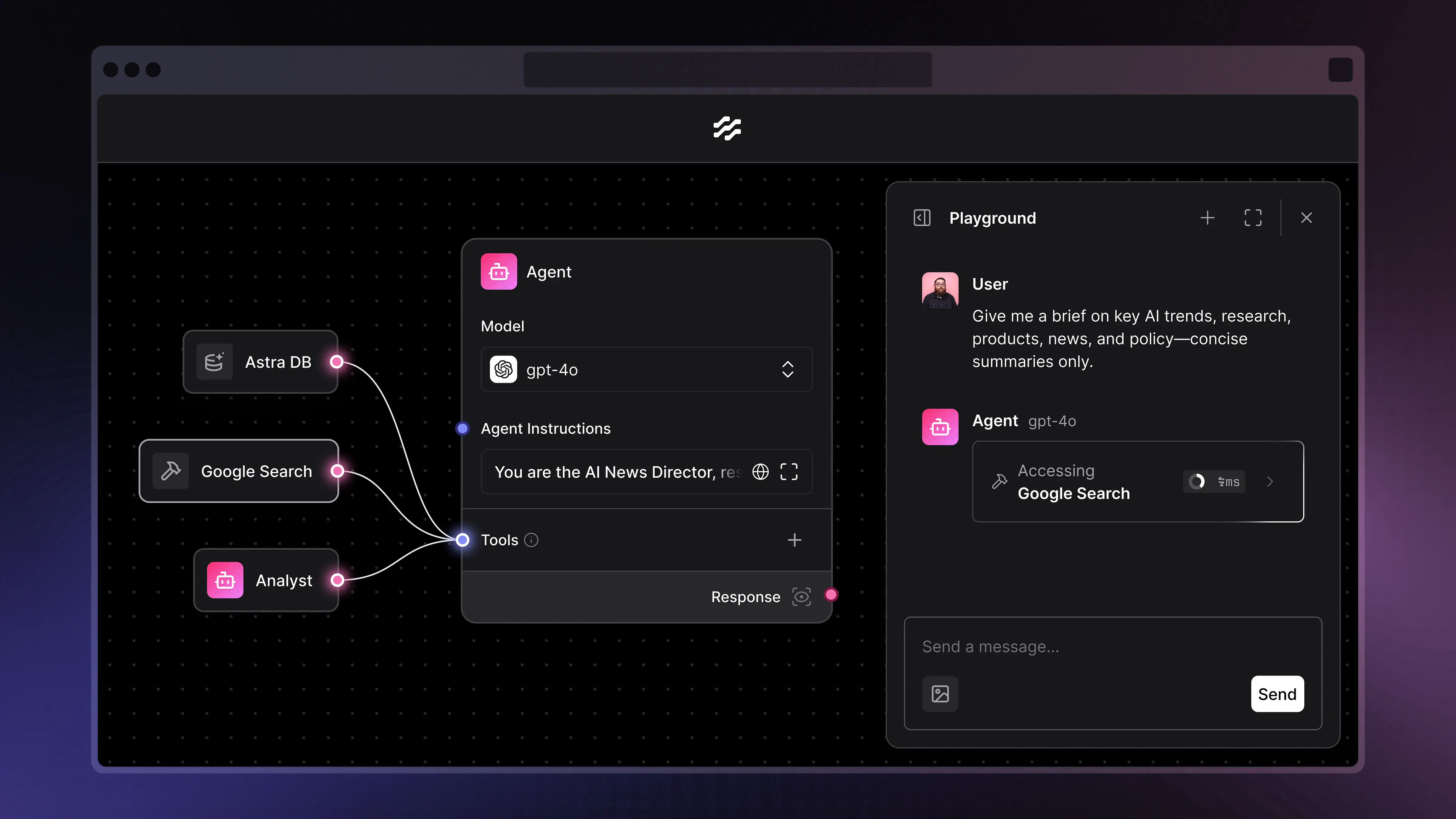 Source: medium.com
Langflow has the largest community of any tool in this comparison by a significant margin: 140,000+ GitHub stars puts it ahead of the other three combined. That community translates into a broad ecosystem of components, templates, and third-party integrations, and a support network that makes it easier to find answers when things go wrong.
Its visual canvas handles multi-agent workflows, RAG pipelines, and custom components on the same surface. The feature that sets it apart from the other three is MCP server export: Langflow can deploy any flow as an MCP server, turning your workflow into a callable tool for another agent. That's an interoperability approach the others haven't matched.
Strengths:
- Largest community and ecosystem of any tool in this comparison: 140,000+ stars
- Can export any flow as an MCP server, the strongest interoperability angle in this group
- Model-agnostic with broad integration support
- MIT license is genuinely permissive, with no additional conditions
- Self-hostable via Docker or pip
Limitations:
- Python-only backend, a hard stop for TypeScript-first teams
- Multi-agent support is workflow-centric, not team-centric
- No built-in observability. Requires external tools like Langfuse or LangSmith for anything production-grade
- Collaboration features are weak: flows are fully isolated per user, with no cross-user visibility or real-time editing
MadAppGang's take: The MCP server export feature caught our attention. It's an elegant approach to interoperability that most tools haven't thought through. Being able to turn any workflow into a callable tool for another agent opens up composability patterns that are hard to achieve otherwise. The lack of built-in observability is a real gap though; for anything running in production, you'll be reaching for Langfuse or LangSmith regardless.
Best for: Python teams that prioritize community size, ecosystem breadth, and MIT licensing above all else. Particularly strong for teams building workflows that need to be exposed as MCP tools to other agents. No other tool in this comparison supports that pattern natively.
n8n
Status: Active. Most-starred tool in this comparison.
Stack: TypeScript/Node.js
License: Sustainable Use (fair-code) | Self-hosting: Docker (best in class) | MCP: Full
GitHub stars: 150,000–179,000
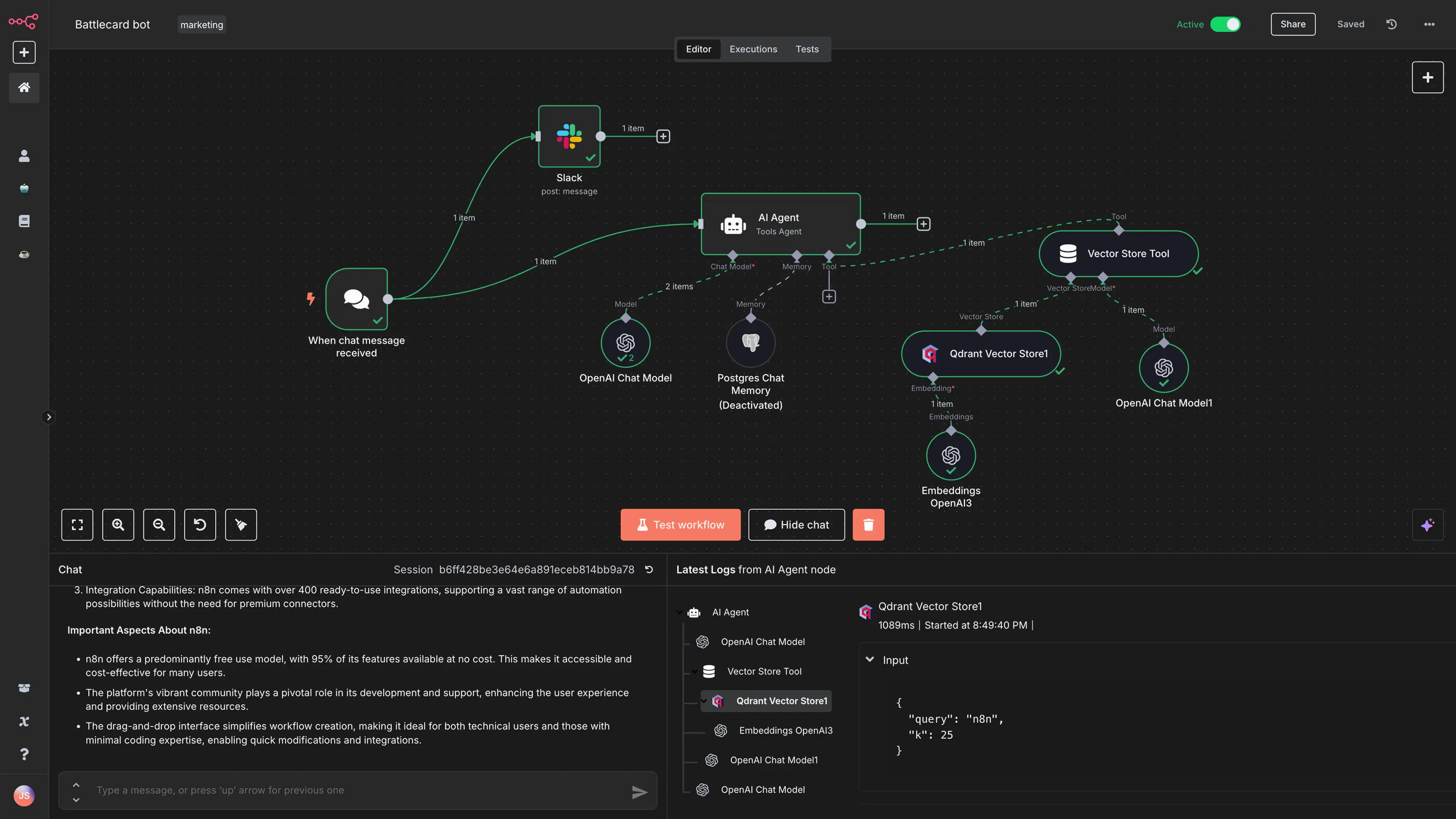 Source: n8n.io
n8n is the most widely used tool in this comparison and arguably the most widely used self-hosted automation tool in the world. Its 400+ native integrations and reference-quality Docker setup make it the go-to recommendation for internal automation stacks. The combination of Ollama + Qdrant + PostgreSQL + n8n is the most-cited local AI stack in self-hosting communities.
What n8n does well, it does better than anyone else in this group. The integration breadth is unmatched, the Docker self-hosting experience is the smoothest of the four, and the community is enormous. AI Agent nodes add multi-agent coordination patterns on top of an already capable workflow engine.
Strengths:
- Most integrations of any tool evaluated: 400+ native connectors
- Best Docker self-hosting experience in this comparison, the gold standard for local AI stacks
- Full MCP support
- TypeScript/Node.js stack
- Largest community of the four
Limitations:
- The Sustainable Use License is not true open-source. You cannot embed n8n in a SaaS product, resell automation as a service, or use it as the engine of a commercial platform without a commercial license. This is a hard stop, not a grey area
- n8n is a general-purpose workflow automation platform. Agent orchestration is one capability among many, not the primary architectural model
- Lacks autonomous planning, self-correction loops, and agent evaluation tooling native to true orchestration frameworks
- No role-based agent composition
MadAppGang's take: n8n's Docker self-hosting stack (Ollama + Qdrant + PostgreSQL, zero cloud spend) is the best local AI setup we came across during the research. If you're building internal tooling and don't need true agent behavior, it's an easy recommendation. For a real-world example of what this looks like at team scale, here's how our 50-engineer team used AI tooling to cut an 18-month migration to 8 weeks. The license is the stopper for commercial products. We flagged it repeatedly in our internal notes: the Sustainable Use License rules out any SaaS context, full stop. If you're building a product rather than internal tooling, this is not the tool.
Best for: Teams building internal automation tools, DevOps workflows, and internal tooling where the process is well-defined and agent behavior is a complement rather than the core. The license restriction is a hard stop for anyone building a commercial product on top of n8n's engine.
Sim Studio
Status: Active development. YC W25.
Stack: TypeScript/Next.js, Bun runtime, PostgreSQL
License: Apache 2.0 | Self-hosting: Docker Compose, Kubernetes | MCP: Native
GitHub stars: 21,800+
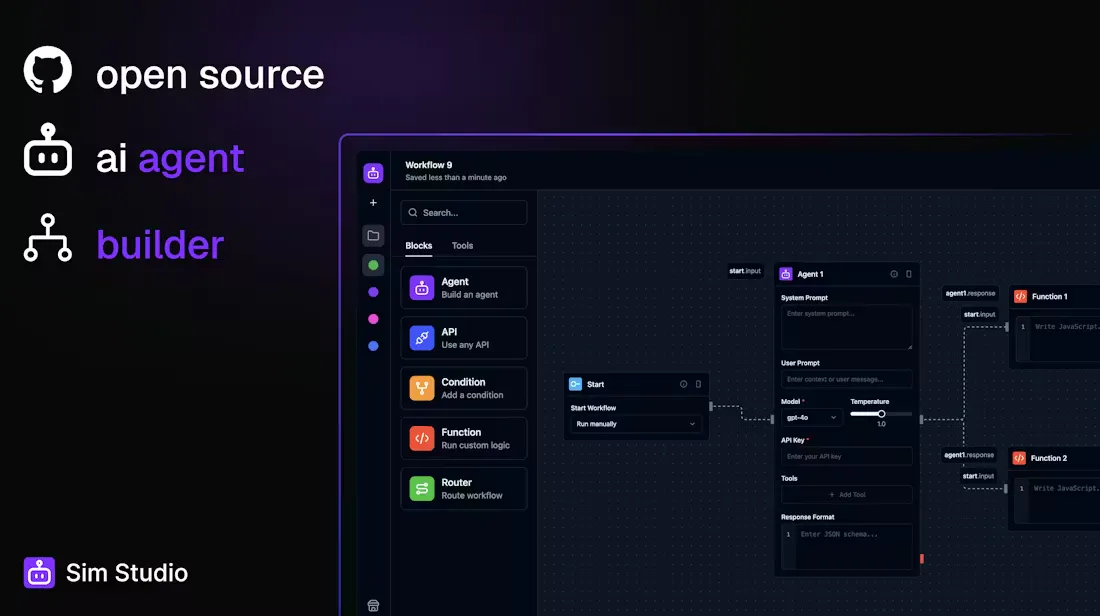 Source: producthunt.com
Sim Studio is the youngest tool in this comparison and the one most purpose-built for the use case these four tools are ostensibly competing on: visual agent composition. It's the only tool here that checks all four boxes simultaneously: visual composition, TypeScript-native, self-hostable, and Apache 2.0 licensed with no additional conditions.
Its canvas is Figma-like in feel: you connect agent blocks, tool blocks, and logic blocks (routers, conditionals, loops) with typed connections between nodes. MCP servers and 80+ native integrations can be assigned directly to agent nodes. An AI Copilot generates workflow nodes from natural language. Run history and execution traces are built in. Ollama support enables local models. It also claims SOC2 and HIPAA compliance, relevant for healthcare and fintech teams. That matters more than it might seem — 89% of AI APIs are currently running insecure authentication.
Strengths:
- The only tool in this comparison that is TypeScript-native, visual, self-hostable, and Apache 2.0 simultaneously
- Native MCP support plus 80+ integrations assignable directly to agent nodes
- Sequential, parallel, conditional, and loop orchestration patterns on the canvas
- PostgreSQL + Drizzle ORM + pgvector for persistence and vector search built in
- Kubernetes support in addition to Docker Compose, a stronger production deployment story than the others
- Claims SOC2 and HIPAA compliance
Limitations:
- Youngest project in this comparison, less battle-tested than Flowise or Langflow
- Agent team composition is workflow-centric rather than role-based; no "role, goal, backstory" equivalent to CrewAI's model
- Documentation still maturing
- No built-in evaluation or testing framework
- Smaller community than the other three: 21,800 stars vs. 38,000–179,000
MadAppGang's take: Sim Studio kept surprising us during evaluation. It's a young project, and the documentation occasionally shows it, but the canvas experience is polished in a way that newer tools rarely are. For TypeScript teams, this was the clearest answer to "I want AutoGen Studio, but production-ready and not Python." The Kubernetes support and SOC2/HIPAA compliance claims matter for enterprise and regulated-industry clients in a way that the other tools in this group can't match.
Best for: TypeScript developers who want a production-ready, self-hostable visual agent builder with no license restrictions. The strongest choice for teams building commercial AI products, regulated-industry applications, or anything that needs Kubernetes-grade deployment from the start.
Head-to-head: which tool wins for which team
TypeScript team building a commercial product
Winner: Sim Studio
 Source: github.com
Flowise is the alternative, but the Workday acquisition introduces uncertainty that matters when you're making a multi-year technology bet. Sim Studio's Apache 2.0 license with no additional conditions, Kubernetes support, and SOC2/HIPAA compliance make it the more defensible choice for anything commercial. The smaller community is the trade-off. You'll hit fewer answered Stack Overflow questions, but you'll also hit fewer licensing surprises.
Python team that wants the biggest ecosystem
Winner: Langflow
 Source: github.com
140,000+ stars, MIT license, Docker and pip install, model-agnostic, and the MCP server export feature that none of the others have matched. For Python teams that aren't worried about observability gaps and are willing to plug in Langfuse or LangSmith, Langflow's community size compounds over time in ways a smaller ecosystem can't.
Team building internal automation, not a product
Winner: n8n
 Source: wikimedia.org
400+ integrations, the best Docker self-hosting experience in the space, and a reference-quality local AI stack. If you're not building a commercial product and don't need true agent behavior as the core architectural model, n8n's workflow automation capabilities outclass the other three. Just read the license before you start.
Team that needs human-in-the-loop natively
Winner: Flowise
 Source: github.com
AgentFlow V2's Human-in-the-Loop node is the only native implementation of approval gates in this group. If your use case requires human review before destructive actions such as database writes, financial transactions, and deployment approvals, Flowise is the only tool here that handles it without custom implementation.
Team exposing workflows as tools to other agents
Winner: Langflow
Source: github.com
The MCP server export feature is a unique capability in this group. If you're building in a multi-agent ecosystem where workflows need to be callable by other agents, Langflow's ability to deploy any flow as an MCP server is a genuine architectural advantage that the other three can't replicate today.
Enterprise team with data sovereignty requirements
Winner: Sim Studio
Source: github.com
Kubernetes support, SOC2 and HIPAA compliance claims, Apache 2.0 license with no additional conditions, and a TypeScript stack that most enterprise engineering teams can work with. Flowise is the alternative, but the Workday acquisition complicates long-term data sovereignty commitments.
The decision matrix
This matrix will help you choose which visual agent builder wins for each team profile:
| If your team looks like this... | Use this tool |
|---|---|
| TypeScript, building a commercial product | Sim Studio |
| TypeScript, want the most battle-tested option | Flowise (watch the acquisition) |
| Python, want the biggest community and MIT license | Langflow |
| Any stack, building internal tooling only | n8n |
| Need human-in-the-loop natively on the canvas | Flowise |
| Need to expose workflows as MCP tools | Langflow |
| Enterprise, data sovereignty, Kubernetes | Sim Studio |
| Regulated industry (healthcare, fintech) | Sim Studio |
What none of these tools solve
It's worth being direct about the ceiling these four tools share, because it affects any team that eventually outgrows the visual layer.
All four treat agents as nodes in a workflow rather than as autonomous team members with roles, goals, and delegated authority. If you need the "crew" metaphor, where agents reason about their own responsibilities, delegate dynamically based on context, and maintain state across long-running sessions, you'll hit the ceiling of visual workflow builders regardless of which one you choose. We ran into this ceiling ourselves — here's what we learned building 30+ agents in practice.
When that happens, the natural next step is pairing one of these visual tools with a code-first orchestration SDK. For TypeScript teams, Mastra AI sits alongside Sim Studio well: Sim Studio handles the visual composition layer, Mastra handles the orchestration engine beneath it. That combination covers more of the feature surface that production multi-agent systems actually need than any single tool in this comparison does alone.
Conclusion
After running this comparison ourselves, our take is straightforward. Sim Studio wins for TypeScript teams building commercial products. Langflow wins for Python teams that prioritize community and ecosystem. Flowise wins when human-in-the-loop is a hard requirement. n8n wins for internal automation where the license restriction isn't a concern.
The tool that fits your team isn't the one with the most stars or the most integrations. It's the one whose architectural model, license, and deployment story match where you're building and what you're building it for. The four tools in this comparison are genuinely good at different things. Pick the one that's good at your thing. Once you've chosen your builder, these 13 workflow tips from Claude Code's creator are a practical next step for getting the most out of AI-assisted development.

